Family Caregiver Support

Stories and Strategies to Help You Juggle the Challenges of Long-Term Care

  • Home
  • Caregiver News
    • Anti-Immigrant Policies Worsen the Labor Shortage in Home Health Care
    • Stress-Free Senior Caregiving: 4 Tips to Make the Job Easier
    • Should You Plan for Long-Term Care Expenses
    • Financial Tips for Helping a Senior After a Loss
    • Yoga Is an Important Stress Reducer for Caregivers
    • Diabetes Coverage: Tips to Help Seniors Plan Ahead
    • The Do’s and Don’ts of Caregiver Self-Care
    • Resources for Senior Caregivers
  • Book Table
  • About
  • Contact
  • Opt-out preferences
You are here: Home / Home

Are We Doomed If Our Telomeres Shrink?

August 16, 2015 by Marylee MacDonald

Photo Source

Why does skin wrinkle and lose elasticity? Because our bodies’ stem cells produce less collagen as we age. Stem cells are also responsible for maintaining the bone mass of our skeletons. As the volume of bone decreases, we become more prone to broken bones. Stem cells are not just present in unborn children. They are present in adults. Learning how to stimulate adult stem cells without triggering rampant cell growth (e.g. cancer) could herald the dawn of an age where people live longer and healthier lives.
 
“Losing our health is the single biggest concern we all face.” So says Dr. Jill Helms, Professor of Surgery at Stanford University. “Our immune system and biology evolved for us to live till about fifty.” But, she argues, it doesn’t have to be that way. Within the next ten years, she predicts we’ll find people in their eighties and nineties living vigorous, active lives.
 
And who can argue with that? As many of us unfortunately know, health issues will derail whatever plans we’ve made for work, hobbies, or family fun. It’s not just the time-suck of doctors’ visits or poring over the fine print in the insurance policy. It’s the worry that cocktails of poisonous chemicals and repeated zaps of radiation might not help. But what if your body could heal itself?
 

Longer and Healthier Lives

What if medicine could mobilize the body’s own healing mechanisms? Breakthroughs at the California Institute for Regenerative Medicine have already figured out how to re-grow bones. This is not science fiction. More breakthroughs are just around the corner. “The key thing to understand,” Helms says, “is that when a cell divides, its DNA must be protected by telomeres on the tips.”


Regenerating Damaged Organs

The good news is that there’s an enzyme called telomerase that both protects and, to some extent, “regrows” telomeres. The research that won microbiologists Blackburn and Greider a Nobel Prize for Medicine found that telomerase can rebuild shortened telomere-caps. If telomeres stay healthy, that will delay aging. Living to a hundred will no longer be the exception.
 
“A better biology can heal humanity,” Helms says. But telomerase by itself won’t do the job. That’s because telomerase is also closely linked to rampant cell growth, meaning cancer. The key to controlling the benefits and avoiding the problems of telomerase lies in continued funding for stem cell research.
 
Stem cell research has been controversial because the research uses cells from human embryos. Federal funding has been cut off, due to lobbying by right-to-life groups. In 2003 the California legislature voted to fund the California Institute for Regenerative Medicine. The state funding brought $279,005,859 to Stanford and put them in a worldwide leadership position. It also freed researchers from dependence on federal funding.
 

Two Kinds of Stem Cells

When embryonic stem cells divide, the two new cells are exact copies of the original. They’re clones. Embryonic stem cells can make any cell that is present in the adult body. Think about that. Any cell in the human body.

But not all stem cells are embryonic. Stem cells change character very quickly. Soon after conception, stem cells begin to differentiate.
 
early cell division
 
At six weeks in utero, a baby is, in effect, already composed of adult stem cells. Brain cells have become a brain. Kidney cells are on their way to becoming kidneys. Blood cells have become blood.
 
As we age, our stem cells continue to maintain tissues in the hair, gut, and blood. These parts of our body are maintained because stem cells are reproducing them. Although we have adult stem cells, their biology restricts what they can do. That is because stem cells’ potency changes over time. When adult stem cells start to age, there are changes. We have less hair, or our hair turns gray.
 
The good news is that we still have stem cells, even though they may be damaged. The key thing is to get them to be robust again. Ironically, this is starting to sound a lot like cancer: cells that run rampant and whose growth we don’t know how to stop. And, that is indeed the problem.
 
Stem cells and cancer cells are very nearly identical. If we can understand what makes stem cells regenerate, then we can regenerate lost tissue. But understanding the growth mechanisms of stem cells may also put us closer to a cure for cancer. Cancer cells are immortal; they keep on growing, no matter what.
 

WNT and Stem Cells

What would it take to regenerate our damaged organ parts? Could we do it with stem cells? How is it that some animals can regenerate whole organs, and we can’t? What makes regeneration possible?
 
WNT controls the on-off switch that stimulates stem cells. Here’s what Genetics Home Reference has to say about WNT. “Researchers have identified 19 genes in the WNT gene family. These genes provide instructions for making similar proteins that participate in chemical signaling pathways in the body. Some WNT proteins are specific to certain cells and tissues.”
 
WNT signaling is frequent in young stem cells but decreases as we age. When WNT is over-active, it causes cancer.
 

Telomeres + Telomerase + WNT = A Ripe Old Age

Jill Helms says that WNT is the protein that also regulates telemetry (meaning the interaction between the telomeres and telomerase). WNT activates stem cells, and understanding how this mechanism works on the molecular level is the key to understanding tissue regeneration. Because WNT is a recombinant protein (meaning its DNA can replicate itself), WNT can be delivered outside the body.
 
Are you with me here? I thought not. Let’s back away from the jargon and look at the potential.
 
The folks at Stanford think that it might be possible to add WNT to specific sites in an older person: a stroke-damaged brain or broken bones, for instance. Let WNT activate the damaged stem cells. Regrow grandma’s hip socket. Helms pointed out that this also has the potential to mend bones that are now held together with screws and titanium plates.
 
On the surface, this sounded to me like a perfect thing to regenerate motor neurons, but Helms said that MND (motor neuron disease) is in a “nonspecific area.” WNT would only work for a specific area, and that’s because of its powerful stem-cell activation capabilities. (Motor Neuron Disease is the same thing as ALS, or Lou Gehrig’s disease.)
 
Folks at Stanford have had a great deal of success regenerating bone. They harvest the bone marrow from a damaged site, and they put that in a Petri dish and add WNT. Then they return the marrow to site where they want the bone to regenerate. It makes a lot more bone, and the bone is the right shape for where it’s located. A hip socket, for instance, regenerates into a proper hip socket.
 
Among the groups working in California is the California Center for Regenerative Medicine, ANKASA—a company formed to bring these discoveries to humans. Right now they are only focusing their research on diseases that have no cure. Drug companies typically need 20 months to do the safety and efficacy tests necessary for FDA approval, but ANKASA is trying to fast-track the results of their research so that it will benefit those who need it now.
 
If you’re interested in learning more about the details of this research, here’s a link to the University of Utah’s Health Sciences Center. It will give you some insight into the discoveries that continue to unfold. But, don’t rush out and buy the telomerase-enhancing supplements sold on YouTube. Stomach acid will destroy the enzyme before it can be absorbed into your circulatory system and delivered to the telomeres on the tips of your DNA.
 
So what do you think? Would you like to have your hip socket grow back instead of having a hip replacement? What if this led to a cure for cancer?

Night Sky Fireworks: Caregivers, Look To The Sky

August 8, 2015 by Marylee MacDonald

Even when caregivers can’t leave home, they can still take a mental break by gazing up at the heavens. Paying attention to what’s happening in the sky is one way to escape the brain freeze that comes from being indoors all day and from taking care of a sick person. When you step out onto the porch, can you see the moon? Do storm clouds cover the entire sky, or are the stars peeking through?

What about astronomical events that happen only rarely: a solar or lunar eclipse? Mark Twain built the plot of his novel, A Connecticut Yankee In King Arthur’s Court, around the day the sun went dark and spread fear throughout the realm. To observe a solar eclipse, you need to make special preparations. Meteor showers happen more often. If you have a van with a lift or an RV, a campground is the perfect place to see this spectacular display.

View image | gettyimages.com

In 2015 the Perseid meteor shower began on August 12 and continued till August 26. If you didn’t make it this year, read this article from Star and Telescope and get organized for the next one. And, here’s a calendar that will give you dates for the next two years of meteor showers. Nothing is more fun that lying in a sleeping bag, all warm and toasty, and looking up at nature’s fireworks-display.

The most exciting astronomical event of August 2015 is the Perseid meteor shower. The shooting star event that peaks in mid-August will light up the night sky offering a spectacular sight for the astronomy enthusiasts. Here is a guide to all the […]

Click here to view original web page at en.yibada.com

Stargazing Apps to Navigate the Night Sky

Now, here’s the real reason astronomy fascinates me. Four years ago I began writing a historical novel, The Vermillion Sea. One of the main characters is the French astronomer Chappe d’Auteroche. He is frantically trying to reach the tip of Baja California in time to set up for the Transit of Venus observations of June 3, 1769. Two weeks before that date, he lands on the desolate beach near San Jose del Cabo. His diary records his joy as he stares up at the stars. Of course, Baja would be an extraordinary place to see them. A cloudless sky. No doubt Chappe could identify all the major constellations.

The night sky is a big place, and if you’re like me, you can probably find the Big Dipper. I was at my sister’s house recently, and she showed how her iPad could bring up the constellations. I’m using an app to backtrack to the date in 1769 that Chappe would have found himself on that beach. To write the scene accurately, I need to know what Chappe saw when he looked up.

Here are a couple of places to find apps for iOS and Android devices. If you have an iPad, check out these ten apps. If you have a favorite app that lets you track the stars, please leave a comment. Also, where have you had your best view of the night sky? On vacation, at sea, or in the mountains? Did you have trouble identifying the constellations, or do you know the main ones? As for me I envy people who can identify the signs of the Zodiac. It would be so comforting to look up there, and in all that vast expanse, know what I was looking at.

Protect Your Telomeres and Live 9 to 17 Years Longer

August 8, 2015 by Marylee MacDonald

Photo Source

Our spirits lift when we’re away from our routines and in a beautiful place. The opposite happens when we’re too busy and can’t take a break. Prolonged stress isn’t good. We don’t sleep well. We’re tired and short-tempered. But does ongoing stress actually harm our health? If so, how, or is that an urban legend?

Turns out that prolonged stress damages our telomeres. Research into telomeres and the enzyme that repairs them, telomerase, has found a measurable connection between aging, stress, and health.

Until a year ago, I’d never heard the word telomere, but one day my friend and fellow writer, Margaret Ann Spence, the mother of a special-needs son, was talking about how draining it was to be on call 24/7. As parents reach their sixties and seventies, it just isn’t possible for a parent to do the heavy lifting. That ushers in another stressful time. Parents confronting their own mortality must make provisions for their adult children’s care.

While making the transition from caring for her son at home to finding a care-home, Margaret had stumbled on a Nobel-prize-winning study of mothers with special-needs children. She thought readers of this blog might be interested. Well, Margaret was right. The data was shocking. Turns out that the prolonged stress these women were under had caused their telomeres to shrink. That put their health at risk. I wanted to know more.

What Is A Telomere?

The word telomere is derived from the Greek word telos (τέλος), meaning “end.” Put simply, a telomere is like the tip on your shoelace. Strands of DNA have caps on the end. These caps are called telomeres. Young DNA strands have long telomeres. However, telomeres shrink with age and stress.

How did molecular biologists figure out the correlation?

They studied two groups of mothers. One group had children with profound disabilities. The other group was made up of moms whose children were developing normally. The researchers could count the hours the moms had to deal with their kids. They asked what kinds of tasks the moms performed and how much they slept. All that data was measurable. Then, they took blood samples. The telomeres of the moms with higher stress levels grew shorter over time.

Elizabeth Blackburn and Carol Greider (Blackburn’s graduate student) won the Nobel Prize for Medicine for this discovery. A professor at the University of California, San Francisco, Blackburn’s piece of the stress-puzzle was to take blood samples and measure the telomere-lengths of mothers in the two groups. Long-term caregiving had shortened the telomeres of the special-needs’ moms by as much as nine to seventeen years. Yes, that’s years, not months. The longer the person lived the life of a caregiver, the shorter her telomeres.

Shorter telomeres are associated with “biologic aging”—how old your body thinks it is. Telomeres are timekeepers. Factors like obesity and smoking shorten telomeres. And, now, we know that stress does, too. What’s a mother to do?

Help for Solo Moms of Disabled Children

I just ran across a book that could be a valuable resources for single mothers of disabled children (and for any other long-term caregiver). It’s called Going Solo While Raising Children with Disabilities and it’s by Laura E. Marshak (ISBN 9781606131800). Here’s a synopsis from the back cover.

“It’s a fact that children with disabilities are more likely than other children to be living in single-parent homes. If you’re raising a child with disabilities on your own, whether by choice or circumstance, you’ll find a wealth of support, affirmation, and practical ideas in this guide to living well. Going Solo While Raising Children with Disabilities is the first book for single parents (whether they are ‘solo parents’ by becoming widowed, separated, divorced, single by choice, adoptive or foster parents, or military spouses with deployed partners) whose kids have a wide variety of disabilities, whether they are physical, neurodevelopmental, and/or psychiatric. Going Solo While Raising Children with Disabilities, by Laura Marshak,… skillfully weaves together extensive interviews and survey results of solo mothers and fathers (and grandparents, too) with reliable coping strategies gleaned from 25 years as a practicing psychologist and specialist in disability adjustment. [The book] is replete with insightful personal narratives and the author’s deconstruction of these to offer universal lessons ranging from the basic (e.g., practice mindfulness to de-stress), to the profound (e.g., cultivate gratitude as the antidote to resentment), and will help readers assess and transform their own lives for the better. Agencies, extended family, and friends will want a copy of this book, too, to support the solos they care about.”

And here’s a glowing review from the Chicago Book Review:

Exceptionally well written, organized and presented by a truly knowledgeable practitioner, “Going Solo While Raising Children with Disabilities” is as informed and informative as it is thoroughly ‘user friendly’ from beginning to end. Very highly recommended for personal, family, social service agency, community, and academic libraries…an absolute ‘must’ for anyone charged with the responsibility of providing for the needs of children with disabilities.

I’m going to add this book to my Book Table! I’ll see if Dr. Marshak will do a guest blog; but, meanwhile, I’d like to know what has worked for you. What do you want to share with people in prolonged caregiving situations? Do you remember the stress, or are you currently in the middle of it?

What A Train Can Teach Us About Life

August 4, 2015 by Marylee MacDonald

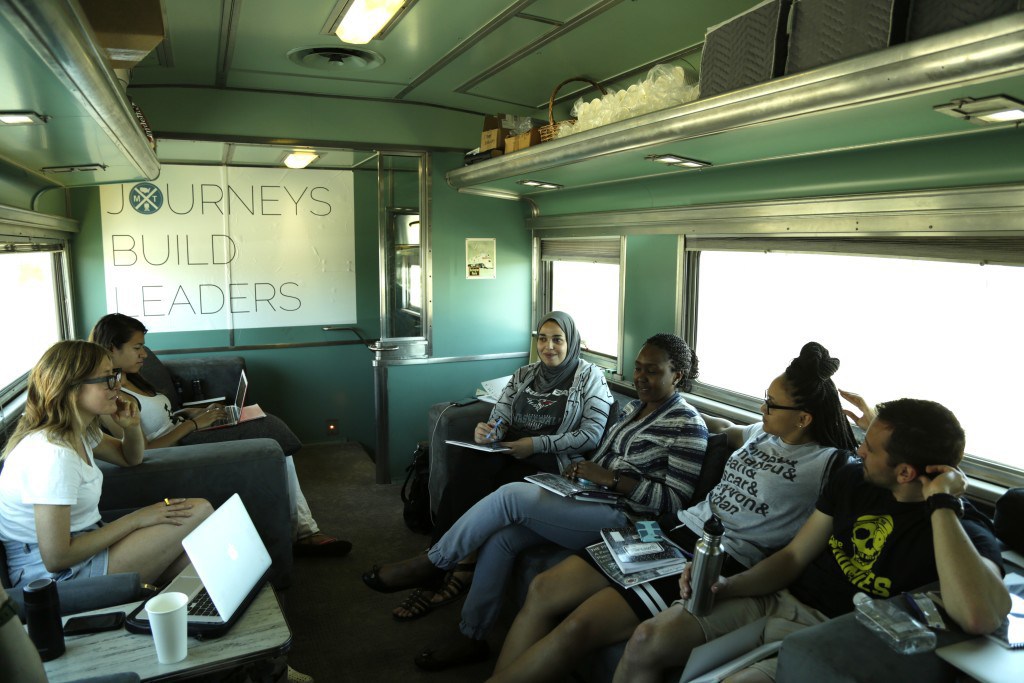
The Millennial Train Project brings together young entrepreneurs.

If life is a journey, The Millennial Trains Project is one train I’d like to board. This train brings together people from very different backgrounds and teaches them how to take charge of their own destinies. The Trains Project is happening all over the globe.

I love the idea behind this entrepreneur-inspired effort. I love the idea that we can muster our creativity, but not have to go it alone. How much fun it would be to ride a train with other folks intent on the same mission–caregiving, let’s say. But in this newspaper article, the riders on the train were learning how to run a business.

The Millennial Trains Project repurposes trains as platforms for inclusive innovation. (Photo: Millennial Trains Project) Today, in Washington, DC, the White House is hosting its first-ever White House Demo Day to spotlight entrepreneurs from diverse backgrounds and platforms for inclusive innovation designed to help them move forward. The Millennial […]

Click here to view original web page at voices.nationalgeographic.com


View image | gettyimages.com


Amtrak’s Train Residency Program

In 2014, Amtrak decided to use its trains for an #AmtrakResidency. The recipient of the first Amtrak writer’s residency, Jessica Gross, published “Writing the Lakeshore Limited” in The Paris Review. She compared a train ride to a writer’s garret. In the time bracketed by the beginning and end of the journey, she says a writer can dip into her subconscious. And, here’s a line I really like. “Train time is found time.”

Her essay brought so much positive attention to Amtrak that they expanded the residency and chose twenty-four writers to ride long distance trains. A few have begun to file their reports.

The contrast between The Millennial Trains Project and the Amtrak Residency couldn’t be more stark. In the first, people come together. In the latter, each writer hides away in a little compartment. To get the writing done, authors need time alone, but like anyone else, we need moments of connection and joy. As I write this, I’m thinking about a quote from Anne Morrow Lindberg: “Joy can spring like a flower, even from the cliffs of despair.”

And, I think there’s an analogy to be made for caregivers, too. So often caregivers are isolated. If it were easier to come together, it might make things easier.

Transported by Joy

A few years back, I heard author Barbara Ehrenreich speak at the Chicago Humanities Festival. In 2007 she’d published her nonfiction book, Dancing In The Streets. Just prior to her speaking engagement, she’d published Bright-sided: How the Relentless Promotion of Positive Thinking Has Undermined America. In both books she talks about our human need for intense, collective joy.

Our culture gives us few opportunities to experience rituals that connect us to one another. Sure, we have our electronic devices. We can create virtual communities, but those connections can’t replicate in-person contact. Nothing can equal the moment you’re standing next to a stranger, feeling their body-heat, and knowing the smile on their face is mirrored on your own.

I’ve had that experience very occasionally in my life. When I was in my thirties and on safari in northern Kenya, I found myself at a mission church. It was Sunday, I hadn’t been to mass in years, and I expected to be bored. Instead, When the Turkana tribespeople, wrapped in their white robes, began an a capella rendition of “Kumbayaa,” I wiped tears from my eyes. It was the song Joan Baez had sung at Stanford’s Frost Amphitheater, the song from the Poor People’s March On Washington. And, there I was, singing the same song, halfway around the world.

Moments like this take us beyond our own navel-gazing and daily worries. There’s no way to stand there stiffly, hands at your sides. You have to join in!

Here’s Barbara Ehrenreich herself. What a fantastic speech she gave. I hope you like it, too, and I’d love to know if YOU’VE had experiences like this–moments when the boundary between you and the rest of humanity just dissolves. Please leave comments below.

« Previous Page
Next Page »

Book title plus a snowy scene showing a mother and daughter walking up a hill in Vermont
If you like literary fiction where even the characters’ best intentions may not be enough to bridge the gap between them, you’ll love Montpelier Tomorrow.

Recent Blog Posts

  • To Move or Not to Move: The Question Worth Asking Before a Crisis Answers It for You July 5, 2026
  • Letting Go: How to Clear Out Your Home After You’ve Decided What’s Coming With You June 23, 2026
  • What Actually Fits: A Room-by-Room Guide to Downsizing into a Senior Apartment June 9, 2026
  • How to Balance Work, Life, and Senior Care Without Losing Yourself June 2, 2026
  • How to Actually Take Care of Yourself When You’re Too Busy Taking Care of Everyone Else May 6, 2026
  • Avoiding Burnout: Support for New Caregivers February 13, 2025

Featured Books

God’s Gift Within: The Story of the Joshua Quilt

God’s Gift Within: The Story of the Joshua Quilt
Buy This Book Online
Buy from IndieBound
Buy from Barnes and Noble
Buy from Amazon Kindle
Buy from Amazon
God’s Gift Within: The Story of the Joshua Quilt
Buy now!

A Chance to Say Goodbye: Reflections on Losing a Parent

A Chance to Say Goodbye: Reflections on Losing a Parent
Buy This Book Online
Buy from Barnes and Noble Nook
Buy from Barnes and Noble
Buy from Amazon Kindle
Buy from Amazon
A Chance to Say Goodbye: Reflections on Losing a Parent
Buy now!

The Space Between: A Memoir of Mother-Daughter Love at the End of Life

The Space Between: A Memoir of Mother-Daughter Love at the End of Life
Buy This Book Online
Buy from Barnes and Noble
Buy from Amazon Kindle
Buy from Amazon
The Space Between: A Memoir of Mother-Daughter Love at the End of Life
Buy now!

Bonds of Love and Blood

Bonds of Love and Blood
Buy This Book Online
Buy from IndieBound
Buy from Amazon Kindle
Buy from Amazon
Buy from Barnes and Noble Nook
Buy from Barnes and Noble
Buy from IndieBound
Bonds of Love and Blood
Buy now!

Archives

© Marylee MacDonald | All Rights Reserved.